Summary
- 01
GIN found during internal quality control that the stitching securing the plastic paracord may loosen or detach on a limited number of Genie Race 5 rescue handles.
- 02
GIN says displaced paracord can catch around the retaining pin, potentially delaying or, in the worst case, preventing reserve deployment.
- 03
GIN requires a handle check before the next flight; any movement or sliding means the handle must be removed from service and replaced free of charge through an authorised distributor.
Two notices identify the same risk
GIN has issued a safety notice concerning the reserve handle fitted to the Genie Race 5 harness. The identified issue is the securing stitch on a length of plastic paracord within the handle assembly. GIN describes the affected population as a limited number of handles, but the component sits directly in the reserve-deployment path, making this more than a cosmetic manufacturing defect.
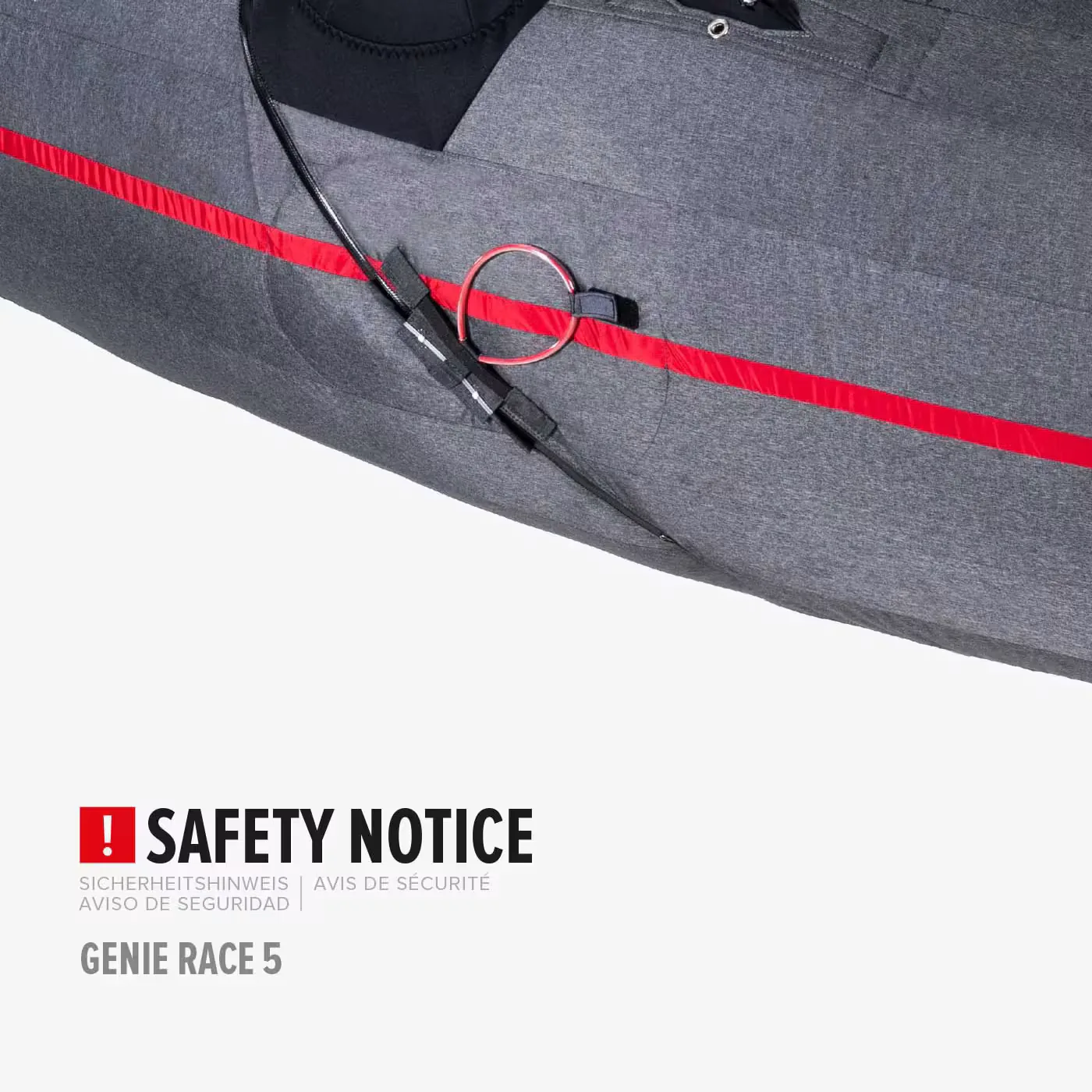
The manufacturer notice is dated 10 July 2026, followed by a DHV safety entry dated 17 July. Together, the two records establish a precise factual boundary: the concern involves some GIN Genie Race 5 rescue handles, the stitch that secures their plastic paracord, and the possibility that deployment may be delayed or prevented. They do not support a broader claim about every handle or other GIN products.
How the stitch can affect deployment
The stitch is intended to keep the plastic paracord in its designed position. If it loosens or detaches, the cord can move. GIN says displaced paracord may catch around the retaining pin, interfering with the mechanical sequence between pulling the handle and releasing the reserve. That mechanism explains why a small piece of stitching carries unusually high operational importance.
The documented consequences have two levels. Deployment may be delayed, or, in the worst case described, it may be prevented. The available evidence does not state a failure rate or quantify the number of affected units, so no incidence estimate can responsibly be made. In a situation where a reserve is required, however, even a possible delay is sufficient to warrant immediate attention.
What the notice means for owners
GIN's formal notice provides an illustrated pre-flight inspection centred on whether the plastic paracord is securely stitched to the rescue handle and whether it can move or slide relative to it. Owners should perform the check directly from the original manufacturer notice linked below; this report does not replace that technical document, and normal appearance or uneventful prior use is not a pass result.
The notice also defines the outcome. If the paracord is securely attached and does not move or slide, the handle may remain in normal use. If any movement or sliding is detected, the handle must be removed from service immediately; the harness must not be flown with that handle installed, and an authorised GIN distributor should be contacted for a free replacement. No field repair is authorised.
The inspection result determines use
Owners do not need to wait for a serial-number list before acting: GIN identifies the rescue handle on the Genie Race 5 and sets the deadline at the next flight. The original PDF, linked below, includes photographs of the relevant area. Any uncertainty about the result should be resolved with an authorised distributor rather than treating an ambiguous handle as serviceable.
The conclusion is therefore specific. The notice concerns a limited number of handles but a potentially severe deployment consequence. A handle that passes the stated check may continue in use; a handle whose paracord moves or slides must be withdrawn and replaced free of charge. This report explains the risk and decision boundary, while the GIN notice remains the controlling technical instruction.